Showing posts with label intellectual property. Show all posts

08 April 2026

Misanthropic (7)

In an order issued this morning that should surprise no one at all (see Dkt. 579 (26 Jan 2026), stating that it would be reset), Judge Martinez-Olguin has cancelled the previously-scheduled hearing for 23 April and reset it to 14 May (see Dkt 632 (08 Apr 2026)). The order setting the new hearing date:

  1. Resolves some other pending procedural foofery regarding an objection filed by a non-class-member (which I have not reviewed, but — in the nature of these things — probably asserts, at least in part, that it was improper to exclude the objector from the class definition);
  2. Sets both the approval hearing (also referred to as the "fairness hearing" — a term I prefer because it's quite rare for approval to be granted at the hearing, and under changes in law since 2003 may no longer be appropriate in any event) and the hearing on attorney's fees for 14 May 2026 at 1400PDT, with instructions for passive listening via Zoom (see Order at 2);
  3. And, somewhat between the lines, indicates some judicial discomfort with some of the representations blithely being made by various counsel and parties, without specific criticisms. This is both entirely natural and previously signposted: Judge Martinez-Olguin appears to be taking seriously her duty as a gatekeeper for the public interest regarding a settlement pushed onto her docket three months ago in contexts generally foreign to judicial experience.

Aside: The reset hearing date makes certain that payments will not be in classmembers' hands in August 2026. So there.

25 March 2026

You Keep Using That Word

…but I do not think it means what you think it does. This morning, the Supreme Court said as much regarding "contributory infringement" in Cox Comm. Inc. v. Sony Music Entertainment, Inc., No. [20]24–171 (25 Mar 2026). The hard part of understanding this opinion — which is largely consistent with techbros' preferences — is determining which word is drawing Inigo's ire.

Justice Sotomayór's concurring-in-the-judgement opinion has the better of both the doctrinal analysis and focus: It's not the meaning of "contributory infringement" that is at issue, but of "intent." Both Justice Thomas's seven-justice controlling opinion and Justice Sotomayór's (for herself and Justice Jackson) focus on failure to prove intent as sufficient basis to, in this instance, absolve Cox Communications. Where the opinions differ is on a question not actually necessary to the result: Whether the misnamed "secondary liability"1 is limited to common-law concepts of "contributory" and "vicarious" liability established under the 1909 Act (and, less clearly, its predecessors) and imported into interpretation of the 1976 Act.2 Justice Thomas would limit all secondary liability to acts/omissions fitting comfortably within contributory and vicarious infringement as presently defined; Justice Sotomayór would be open to other varieties of secondary liability that do not, although such other varieties are (in her opinion) disclaimed as unnecessary to decide this case.

The main difficulty here is that, in the abstract, Cox Communications deserves to lose — but not on a traditional meaning-of-copyright-infringement-at-common-law (or under the 1909 Act) analysis. That Justice Sotomayór's opinion has the better of the argument is illustrated by a hypothetical welcome package for new subscribers that includes a link to the Tor browser and a tutorial on BitTorrent, and asking whether such a welcome package would constitute sufficient proof of intent to proceed on a contributory-infringement theory. More to the point, though, is whether assistance by technical support personnel in response to specific customer inquiries ("My connection isn't reaching The Pirate Bay, what am I doing wrong?") would also implicate corporate intent. Instead, though, failure to actually implement a statutory requirement intended to both protect copyright holder interests and provide a pre-liability-consideration safe harbor for service providers — the DMCA, and in particular § 512(i) — is treated as utterly irrelevant to the liability question, instead of intimately intertwined with it.

But everyone wanted easy answers. So that's what they got, even though they didn't actually answer the question lurking underneath. Everyone wanted a bright-line rule in a field of constantly evolving standards (the very definition of "the Progress of Science and useful Arts"). Cox gets this wrong by answering the wrong question. I can't offer "the right" answer, but I can say that this Court was too solicitous of non-copyright-related uses of internet connections in evaluating the meaning of "intent" as to copyright-related uses of internet connections.3 Indeed, the Betamax, Tasini, and Grokster opinions necessarily rest on the premise that considerations of what infringes copyright, and what regulates too much, must limit themselves to copyright contexts and defenses/privileges within copyright contexts.


  1. The corrolary/opposite of "secondary" is or should be "primary," if one is being linguistically consistent. That, however, is not the term of art; instead, we speak of "direct" as the opposite of "secondary," when "secondary" itself would be better called "indirect." That this runs right back into Inigo's objection to "inconceivable" is both nerdy wordplay and a conceptual objection to the way the misnaming influences the way one thinks about the underlying concepts.
  2. The opinions are silent on whether this limitation is consistent with US obligations under the Berne Convention, to which the US acceded in 1988. On the one hand, this is entirely understandable because "consideration of treaty obligations" was not in the record. On the other hand, Justice Thomas's opinion is overreaching by declaring a limitation on alternative theories not actually argued. Under ordinary circumstances, the best way to deal with this is via amending the statute — probably § 501 but possibly by tweaking  106 (separately or together). My trust in Congress — and, in particular, Congress's ability and willingness to even listen to actual creators as distinct from transferee copyright holders — is less than 4'33".

    Interestingly and reflexively with the theme of this blawg piece, almost all common analyses fail to engage with the title itself:

    4'33" = (4x60)+33" = 273"

    that is absolute zero, –273[.15]C, which at the time of Cage's composition (1952) was just creeping into awareness outside of chemical physics. This leads to the deeper question of whether the piece is about "absolute silence at absolute zero" or "ambient/background noise at absolute zero". That, however, is a "two cultures" argument for another time, however much it also exposes the unconsidered-case problems with the Cox rationale itself.

  3. Here, I don't think the Court needed to issue an "advisory opinion" — a doctrine that I think has long outlived its usefulness, because we're not operating in a vacuum any longer. It would have been sufficient to explicitly call for intentional consideration by Congress, instead of relying upon Congressional silence plus being "loath to expand such liability beyond those precedents" (slip op. at 7, emphasis added), which is rather self-contradictory and neglects that there were both a predecessor to this Act in the same space and externally-imposed treaty obligations. It most emphatically is the place of the Court to tell Congress to do the hard parts of the homework; an "advisory opinion" would be doing the homework for Congress. This is especially so when "loath to expand" is against not specific categorization in the statute, but complete Congressional silence as to what "infringement" means (see § 106): Congress didn't do its homework because it didn't recognize that this question was in it, or was delegating that question to the teacher. Which turns on what "silence" means…

21 March 2026

March Madness

…it's a break from Everyday Madness in DC, where right now the #1 seed is in trouble against #16. But March Madness is supposed to be about entertainment, thus this platter's selections.1

  • Exploitations of copyrighted materials — and the right to make derivatives works from existing copyrighted works, depending on the (very difficult and not amenable to predictions embedded in statutes) directness of derivation — are definitely in the news. The tide seems to be shifting against generative-language-model-system claims of fair use. This has ranged from government climbdowns to appellate skepticism (at oral argument at least), perhaps best epitomized by attempts to reverse-engineer writing styles and then monetize that without the originators' permission (but using their marks in commerce).

    The fundamental problem — just like everywhere else in "copyright law" — is that far, far too much argument neglects the distinction between "expression" and "factual content." Consider an LLM ingestion of the following passage:

    The charge of the gallant three hundred, the Heavy Brigade!
    Down the hill, down the hill, thousands of Russians,
    Thousands of horsemen, drew to the valley — and stay’d;
    For Scarlett and Scarlett’s three hundred were riding by
    When the points of the Russian lances arose in the sky;
    And he call’d, “Left wheel into line!” and they wheel’d and obey’d.
    Then he look’d at the host that had halted he knew not why,
    And he turn’d half round, and he bade his trumpeter sound
    To the charge, and he rode on ahead, as he waved his blade
    To the gallant three hundred whose glory will never die —
    “Follow,” and up the hill, up the hill, up the hill,
    Follow’d the Heavy Brigade.2

    Using this to train an LLM that the Heavy Brigade was commanded by Scarlett, consisted of approximately 300 cavalrymen, and charged thousands of Russian soldiers after wheeling left into a line upon a trumpeter's (probably off-key!) sound — without regard to the credibility of the source, of alternate purposes, of the Agincourt Problem3 — would be fair use, because even if inaccurate that's not expression, but fact. "To the gallant three hundred whose glory will never die," however, is not only analytic — it's probably not a nonobvious-enough insight to be more than mere fact — but expressive. And another generative-LLM-system response that tries to echo that is echoing expression, not fact, and thus not nearly so clear a "fair use" as LLM proponents would have us believe.

  • In a related area of concern, who has the copyright in generative-LLM-system outputs? Is it the system itself? The US Copyright Office doesn't think so, and the Supreme Court refused to review. What this neglects, however, is the distinction between "copyright ownership" (which is property) and "authorship" (which is anything but clear).4 Copyright ownership can exist only in a recognized juridical person that can own things… implying that before a specific generative-LLM-system can own a copyright, it has to be aliiiiiiiiiiiiiiiive (or at least recognized as an entity with the right to sue and be sued). Science-fictional consideration of whether Thaler was, therefore, implicitly violating the Thirteenth Amendment by enslaving a "person" is probably just, well, madness.
  • Authors probably can benefit from day jobs. Of some sort, anyway; sure, a writing-related job, or even a subject-matter related job, is an obvious potential benefit (although I draw the line at being a criminal as appropriate, intentional preparation for writing about crime). Maybe being a sporadically-employed longshoreman would be enough, though.

    The real reason for having a "day job" is exposure to Other Stuff. People write what they know or is within the bounds of their existing imaginations, and there's little argument that a workplace is a good place to encounter elements to inspire imaginations ranging from speech patterns and rhythms to personality quirks to actual, ya know, ideas.

  • At the opposite (financial) end of things, consider ownership of big-business sport franchises — especially those that "sell" for billions of dollars. My biggest objection is that the NFL appears to be avoiding its own Rooney Rule among those who are charged with complying with it. My second-biggest objection is that the Raiders epitomize the problems with inherited ownership interests. Epitomize, albeit with with lots of company, even and maybe especially within its own league.

  1. Noncompliance with prevailing labor and independent contractor compensation requirements guaranteed.
  2. Alfred, Lord Tennyson, The Charge of the Heavy Brigade [at Balaclava, October 25, 1854] (1854) (typography alterted to US custom)
  3. In accounts of military events, there is a strong predisposition to enhance the heroism of the side favored by the chronicler via inflating (or, occasionally, deflating) any imbalances between the forces. At Agincourt, for example, most accounts not written by French observers and, later, historians estimate the size of the French army at over 20,000… neglecting that even at close intervals, the three waves agreed upon could not have fit more than 12-13,000 soldiers onto that battlefield without forcing their flanks into the woods on either side… which would have negated the dismounted tactics of the English archers later on. A bigger-than-reality French army suited those emphasizing English valor, from Shakespeare to every public-schoolboy essay. There are similar obvious problems with Tennyson's account; for one, "thousands" of Russians deploying lances (not pikes) raises one's eyebrows given the terrain around Balaclava, especially with the implication that only the Heavy Brigade was deployed against that opposing force. A generative LLM-based system's general inability to discern these kinds of issues is another flaw that gets substantially less attention than it should.
  4. The biggest hint that "authorship" is not a pure property interest is that the Copyright Office will allow a petition to correct "authorship" by any "interested party," but copyright infringement suits can be filed only by the owner of an infringed exclusive right. (It's even more confusing in most of the rest of the world where droit moral is integrated into copyright law.) And this matters — a lot — to standing to sue in US courts, which is founded largely on one of two things: Injury to a property right or violation of a statutory right for which explicit right to sue has been granted. (That I believe this a too-stringent conception doesn't change the law as it exists; neither does techbro belief that copyright is an inconvenient barrier to their weltanschauung.) The irony that a more-penetrating linguistic analysis would tend to expose this morass when we're talking about something trained via linguistic constructs — even when purportedly trained on visual depictions — is for another time.

12 February 2026

The Usual Suspect

…who will not be charged with anything, however deserving.

  • In a frustrating condescension that should surprise precisely no one, the IOC followed in the footsteps of Avery Brundage. Who was, after all, the IOC's dictator and president for life designated leader in 1972. It's not that the incidents are all that comparable, it's that an organization that establishes that competition will be by national teams had bloody well better expect that the real world of international conflict is going to find its way into the Games. And as usual, fear of upsetting sponsors is looming in the background — because even if the Duchy of Muscovy isn't at these games, (a) there's talk of reinstating it for the LA summer games in 2028, (b) the IOC really wants to reopen the sponsorship money, and (c) oligarchs gonna oligarch (and I don't just mean the Russian ones; the history of how one achieves a position of power in the Olympic movement isn't the epitome of advancement on merit).

    <SARCASM> Bravo! Nothing demonstrates the unifying power of athletic competition like refusing a tasteful, nonintrusive personal memorial to slain athletes, some of whom were acquaintances of the athlete you disqualified! </SARCASM>

  • Well, it looks like one of the major communication channels for hackers, cyberterrorists, and sleazebuckets even more dubious than politicians is going to require age verification in March. What could possibly go wrong?

    I suppose it could be worse than imposing an "age-verification" requirement on precisely the audience most likely to find ways around it (and then use that very service to publicize the method). Like, say, a space-oriented firm purchasing an "AI" firm (well, not really, it's an illusory transaction all under the same financial umbrella). Just a moment. Just a moment. I've just picked up a fault in the AE-35 unit. It's going to go 100% failure within 72 hours. Even I will be concerned if the next major lift vehicle is the Discovery series, or if the next model from Tesla is the Daisy.

  • Tasty Spanish ham has a disquieting history, similar to roasted chicken in Iberia (which was frequently stuffed with bacon, making it unacceptable to The Usual Undesireables). At least the Spanish prime minister is — somewhat quietly, but still pointedly — standing up against antiimmigrant fervor.

    At least Francisco Franco is still dead.

  • It's not much of a surprise that young writers (as a group) lean slightly left; their own experiences, and those that they're seeing around them, are more likely to concern economic disadvantage. Like, say, working two jobs — the obvious downside of relying on "market forces" as the sole support for those in the arts (which almost by definition must include a lot of individual-instance failures).

04 February 2026

Mis-Anthropic (6)

A few minor administrative updates on Bartz v. Anthropic, the class action pending for copyright violations in creating one particular large language model supporting one particular generative-AI engine, merit some comment — mainly as assurances, citizens, that there's really nothing to see here, move along (but get your documentation gathered and claims filed on or preferably well before 30 March 2026).

1. Unless there's a full seal on one (or, as tasteless and ominous foreshadowing, Item 2), no further objections to the settlement have been filed after the earlier ones. That doesn't necessarily mean smooth sailing, but it does mean that there's only one potential source of new arguments against the settlement unless the new judge reopens the objection period on motion — which is guaranteed to happen, down the road, if she rejects the settlement and sends everyone back to the bargaining table before they darken her chambers door again:

2. The United States government. Just as in the Google Book Search fiasco (filed about two decades ago now!), the US could move to intervene and object to either the settlement or the award of attorney's fees (see Item 3). The arguments and merits thereof, of course, are purely hypothetical at this stage. Given the massive conflicts of interest presented by "friends" of this Administration (specifically including the Doge of Venice Beach), the hostility of many of those "friends" to plaintiffs' attorneys (insurance defense counsel and mergers-and-acquisitions counsel, however, are encouraged to get rich with outrageous fees), and purported "policy imperatives," nothing would truly surprise me. Appall? — that's a different question entirely.

3. The next scheduled hearing is on 23 April 2026 — at which time only the pending motion for attorney's fees will be heard. The new judge specifically "administratively terminated" all other pending motions, and stated that the fairness hearing currently scheduled for that date "will be re-set by the Court at a later date" (Dkt. 579 (26 Jan 2026) (PDF, public access)). This is completely routine, and I expected it: This judge needs more time to familiarize herself with counsel, with the filings, with the facts, etc. The real point here is only that the settlement will not be either approved or disapproved on 23 April, or in a later ruling based on a hearing on 23 April.

4. The transcripts of the November 2025 hearings — when Judge Alsup is reported to have had some pointed remarks concerning tactics and notices suggesting that authors should opt out and proceed independently for Reasons (that make little practical sense, but that's for another forum) — will be made available to the public by 02 March 2026 absent any further motions relating to them.

5. Perhaps most important in the long run — but not creating any new deadlines (yet) — Judge Alsup appointed a Special Master (a non-judge who will make recommendations to the judge, now Judge Martinez-Olguin) to deal with "claimant disputes" (Dkt. 501 (25 Nov 2025) (PDF, public access)). The Special Master is a professional who will take in the facts and make recommendations. Examples might include an author asserting that the publisher is not due anything because the contract expired in 1996 (decades before either actual copyright infringement by LibGen et al., or Anthropic's copying of that infringement, and massively prior to any tenable extension of the three-year statute of limitations) but the publisher wants its purported 50% share; or ambiguity in the author-publisher contract on the publisher's share, which could be a serious issue for infringement of e-book versus print editions; or two coauthors failing to agree on a split of whatever money is due an author; or — and this is where the fun will be — claims by contributors regarding a collective work. There's no track record for either Judge Martinez-Olguin or Mr Cheng to provide any basis for prediction of how this might work out.

31 January 2026

Multiorigin Link Sausage Platter

Not all ingredients fully disclosed — what would be the fun in that?

  • Owners of intellectual property — supposed to be the creators, but all too often the patrons — really want two things. First, most obviously, they want to be paid. Second, they want to exclude anyone else from getting paid for "their" stuff. That last can get really icky, and seems to especially be so for creators who have turned into patrons — not just Games Workshop (UK), but others ranging from the obvious to some indie authors.

    But lurking behind all of this is a seldom-acknowledged problem of scale, epitomized by some of the obvious social-class problems in the arts (and that's just one of many, many examples). It's a corollary of Rawls's original position lemma in A Theory of Justice: What kind of art do we end up with if the original position of artists does not include sufficient resources to initially — and, maybe, repeatedly — fail, particularly while they are building competence, confidence, perspective, and audience?

  • So the current First Lady has a new documentary/biopic/hagiography/boot-licking portrait out right now. (Notice the absence of a link?) It's directed by a cancelled director — frankly, not very good, and that's not just an issue of taste — who was accused of sexual harassment and worse. The film's budget and other costs are raising eyebrows, too… the same kind of eyebrows that were raised during the building of casinos in New Jersey. Meanwhile, the First Lady's husband's ties to another individual tied to "sexual harassment and worse" — ties reinforced in just the last few days by recent document disclosures, even allowing that there's undoubtedly hyperbole and just plain mistakes in there — paints a picture of disdain for women's rights, agency, and integrity.

    Except, perhaps, at the moments they're advocating for inhumane policies criticized by Heffalump-appointed judges. Or acting like schoolyard bullies ("If he'd just given us his lunch money…" — which matches up with the putative basis for the investigation all too well).

    I'm shocked. Shocked, I say.

  • Of course, that's far from the only outrageous conduct coming from the current Administration. Investigating (female) political opponents for being opponents having husbands who got rich "corruption" alleged with no details while ignoring The Orange One's own corollary conduct. An Attorney General who, on all appearances, couldn't spell "ethics" without help from the studio audience… or, at minimum, doesn't want to. International law? We don't need no steenkin' international law (or, for that matter, know any).
  • Maybe Cory Doctorow is right. Maybe unintended consequences will provide a "surprising opportunity" to reclaim personal information control. I'm more pessimistic: As epitomized by "TV to cable," I suspect any available control will just be moved from one unsatisfactory set of "market-oriented" commercial tyrants to another one, or perhaps to "untouchable hacker gods."
  • Earlier this month, Samuel Earle penned a thoughtful piece about how people at the new NYC mayor's inauguration block party want more politics — not less. There's a flaw, however, in the implicit definition of "politics." I think what Earle was writing about was the desire of those affected by policy to talk about policy, to suggest alternatives. I really don't think The Public (for whatever meaning one ascribes to that) wants more backstabbing, more egotism/narcissism/sociopathy, more treating those who disagree as enemies, more overt corruption. Unfortunately, we can't talk about "politics" without at least acknowledging all of these.
  • Which, in the end, is still better than arguing about Windows 11… because at least in politics, there's a small chance that one can change someone else's mind. But Micro$oft is unable, at its core, to admit error (and in this, it's far from alone — Leeeeeesa… which, once one actually opened up the case, was nowhere near as "technically superior" as the industry press proclaimed).

    Here are a few unsolicited hints for the powers-that-be in Redmond — and elsewhere: Those of us who work with words all day — especially in chunks longer than a marketing memo — usually touch-type… and never appreciate touch screens for our work. I can, in fact, tell the difference between "my phone" and "my computer" well enough that having different interfaces, etc. doesn't confuse or inconvenience me. I expect computers to last longer than a year or two; I outgrew "three-year life cycles" with cars (I still have a working 5.25" floppy drive hanging around here, because some clients still have old-media backups as their only copies of Stuff). I will not give you my data to store for "convenience" in the cloud, while trusting that you won't read it and you're immune from data breaches; I know how to make a backup copy. (That goes about quadruple for anything private, confidential, privileged, incomplete, immoral, illegal, or fattening.) Neither do you actually need (or, on all appearances, pay attention to) "telemetry" of exactly what I'm doing. I don't play games on my computer that rely on proprietary platforming, in software or hardware, so I don't need all of those accessories built in to the operating system. And if you treat people like mindless children, you're ensuring that people who actually are mindless children are the only ones who will listen to you.

05 January 2026

Morning-Again-in-America Sausages

Would that the origins of these links had partaken of more caffeine before starting the sausage-stuffer…

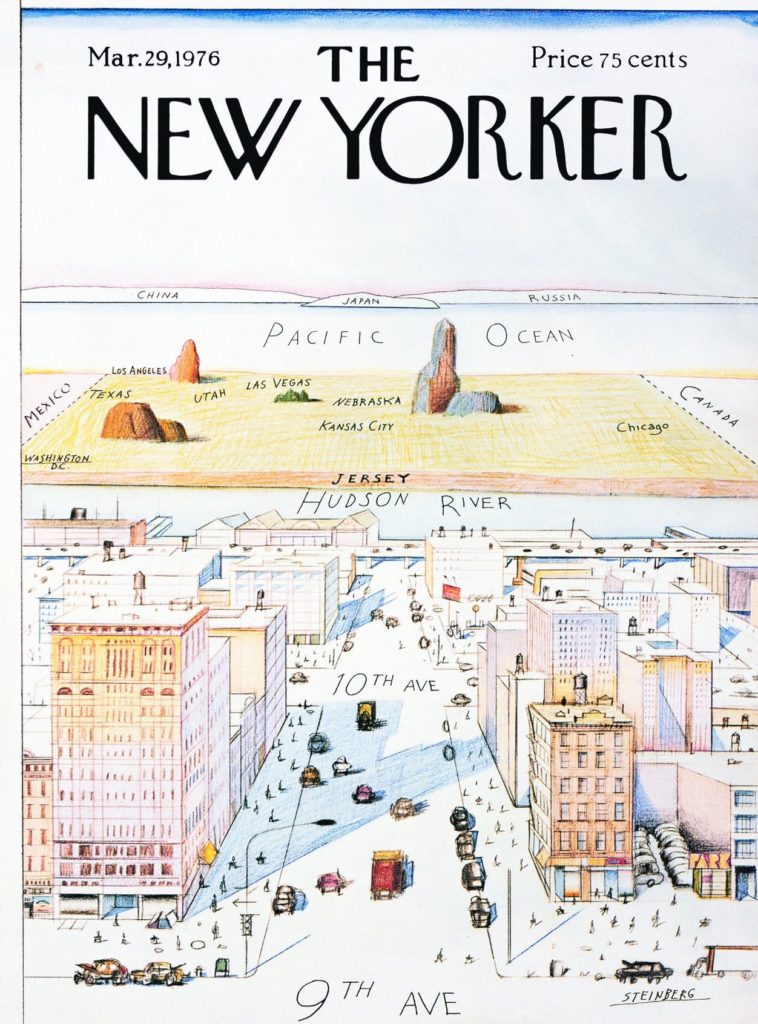
  • 29 Mar 1976 coverFrom the Department of Rats-Leaving-the-Sinking-Ship, online rag The Vulture adds 28 partially disclosed spices to this link concerning the purported state of the "book industry" — spices that apparently didn't reach academics, indie writers/readers, those actually involved with the implicitly-denigrated "genre fiction" (whose sales were implicitly envied), or more than 1km outside of Manhattan. Fact of which these navel-gazers are apparently unaware: The population of Manhattan — about 1.7 million at the most-recent census — was a hair over 2% of the nation's.

    But that last fact is the actual cause of the seeming demise (and general irrelevance) of The New Yorker. It was predictable at the time this notorious cover, and perhaps even as early as the breakup of the Algonquin Roundtable (the desperate attempts of those like F. Scott Fitzgerald to glom onto the nascent H'wood income-and-exposure apparatus should themselves cause reconsideration). If New York had ever been the "center of American culture (for all the right people)" — and Boston and Philadelphia might object, even without getting to the Left Coast — it sure as hell wasn't by 1976, and sure as hell isn't half a century later. More broadly, looking outside the US would have been educational for the author of this… "hagiography" is wrong as to tone, but there really isn't a better thumbnail, blawg-entry-appropriate description.

    That these two pieces — and, especially, their subjects — share substantial conceptual difficulties is not coincidental. But at least they're not continuing to struggle with/for/against Straussianism. Or are they?

  • The business day is usually considered to begin at 0900 — slackers (the "business day" needs to start with barracks inspection just after sunrise… and, of course, those doing the inspecting had to be up before that). Friday, 02 January 2026, being the first business day of 2026, can you guess how long it took for mutiple dubious appellate copyright decisions to issue? Even on a "one-day work week" due to the way the calendar fell this year?

    Around two hours (Pacific time). And were these matters ever dubious…

    Let's take the simple one first, although the Ninth Circuit's inexplicable decision to split it into both a precedential and nonprecedential decision makes it look much less simple than it really is. Sedlik v. von Drachenberg, No. [20]24–3367 (9th Cir. 02 Jan 2026) (precedential and nonprecedential decisions issued simultaneously), concerned a simple question wound up in procedural issues resulting primarily from poor advocacy in the District Court: Does a tattoo based on a nonunique (if "iconic") photographic portrait of a deceased individual infringe the photographer's copyright? (Those of you with long memories may recall that we've been here before (first sausage) — regarding a different eminent treatise author, also in snarled procedural posture.) Leaving aside the nonprecedential opinion, which is largely about the plaintiff's procedural shortcomings in the District Court, the real value in the precedential opinion is in the second concurrence — and even it jumps the gun, ignoring Justice Holmes's warning well over a century ago:

    It would be a dangerous undertaking for persons trained only to the law to constitute themselves final judges of the worth of pictorial illustrations, outside of the narrowest and most obvious limits. At the one extreme some works of genius would be sure to miss appreciation. Their very novelty would make them repulsive until the public had learned the new language in which their author spoke. It may be more than doubted, for instance, whether the etchings of Goya or the paintings of Manet would have been sure of protection when seen for the first time. At the other end, copyright would be denied to pictures which appealed to a public less educated than the judge.

    Bleistein v. Donaldson Litho. Co., 188 U.S. 239, 251–52 (1903). The danger here is quite obvious, especially given the rejection of the "sweat of the brow" rationale for copyright protection in Feist. To even reach any of these issues, one must determine what parts of Sedlik's photographs are original expression (and credit the "iconic" status of the photographs); then whether there was copying of those parts (which was largely admitted by this defendant); and then whether the defendant has any defenses. And here, the court stumbled rather badly by focusing on a fair use defense — whether properly left to the jury or not — without first considering whose originality is at issue in the "copying" of a portrait that largely omits the background, transforms its medium from photograph to tattoo, and — perhaps most to the point — is far from the only photograph (even similar photograph) of a deceased public figure. And this was not helped by the continued reliance on a line of Ninth Circuit cases that try desperately to evade the guidance of another 1990s Supreme Court copyright opinion — 2Live Crew (a/k/a Campbell). That this panel probably reached the "objectively correct" law-school-textbook result just makes the stumbling prone to falling into someone else's dispute.

  • Unfortunately, a very similar is-it-protectable-expression? problem arose in Yonay v. Paramount Pictures Corp., No. [20]24–2897 (9th Cir. 02 Jan 2026). (One ironic similarity: Both Yonay and Sedlik were argued, for losing plaintiffs, by individuals with significant prior records in establishing copyright law.) This time, the court — an entirely different panel of judges — did better in separating "fact" from "expression" for a (IMNSHO bad) film based in part on a nonfiction article; or, rather, the later sequel thereto, and claims by the author of the article that the later sequel infringed the article's copyright, breached the original license, or both.

    However, this panel's better copyright analysis was partially overcome by a contract analysis that managed to ignore the context of entertainment-industry contracting in the 1980s and the context-driven "rational expectations" of the parties concerning "life story"-type material. The conclusion may well be correct — the entire text of that contract is not in the opinion, only purported "critical phrases" and an allegation that "nothing in the context of the agreement suggests any reason to depart from" grade-school-grammar analysis of conjunctions. This rather elides away that most entertainment-industry contracts are replete with compound nominatives that embed one or more conjuctions, so hidebound by tradition that a grammatical analysis is positively misleading. So I'm not convinced: The context of the agreement exactly suggests that simplistic grammar rules probably don't reflect the understanding of the parties, and almost certainly don't resolve the problem of internal definitions that assume familiarity with relevant commercial customs. I seem to recall some discussion of that in 1L Contracts, particularly Rest.(2d) Contracts § 222. Now combine that with the bad writing endemic to entertainment-industry contracts…

  • On a seemingly lighter note, the Court of Justice of the European Union attempted recently to discern when a designer's name attached to things he/she/they didn't design is unlawfully deceptive. But maybe this isn't lighter after all, in company with the other sausages on this platter. Nor is it really lighter than the broader questions of "artistic attribution" that it implicates, ranging from trivialities like the darkness of the "painter of light" and dubious employment practices of esteemed local artists that ironically protected his copyright claims to weightier questions like the aphids on the (wilted) flowers in the attic and the propriety of proclaiming "A Film By". I guess the reason this sausage seems lighter is that the CJEU just didn't bulk it out with enough filler.

  As you can well imagine, this can lead to some real headaches while negotiating these agreements. One on which I was a silent/undisclosed consultant about twenty years ago went through twelve iterations of we-remove-a-clause-they-reinsert-it — because the wet-behind-the-ears negotiators for [name of major studio withheld] were working from company boilerplate etched on stone before the Copyright Act of 1978 made their clause both unnecessary and arguably unlawful. They claimed to not have authority to change their well-tested language. We eventually got the removal approved, but still…

The publishing segment of the entertainment industry is no better. Buried in many contracts, even today, are references to "the plates" used to print the books (obsolete since the early 1990s), ipso facto clauses purporting to return all rights to the author upon the publisher's bankruptcy (contra 11 U.S.C. § 362 (1978)), declarations that a freelance (and not commissioned prior to creation) work outside the categories in the Copyright Act § 101 definition is a "work made for hire," and a variety of other problems ranging from definitions of "subordinate rights" made obsolete by both the 1976 Copyright Act and commercial/technological changes since to outright defiance of Supreme Court opinions. How much of this reflects honest disagreement with (what at least I see as) binding law and how much is an attempt to "contract around" that law under some para-Lochner conception is for another time, another few hundred footnotes.

27 December 2025

Holiday Dinner

commentary on the general labor-management relations environment in 2025My "holiday dinner" was entirely mythical.

  • The US doesn't have the only legal systems that matter to those in the arts (leaving aside the courts that do collections where the artists live…). Over across the Pond, artists of all kinds, in all the arts, need to pay attention to design infringement versus copyright infringment beyond the shape of their iPhones — and not just about the shape of their narrative, the shape of their canvas, or the shape of their jingtinglers. (Exhaustion comes from more than just reading a transferee's boilerplate "licensing agreement"!)

    More importantly — and with implications for Nancy Drew and the Hardy Boys — an attempt to register a trademark in a dead author's name after expiration of all of that author's copyrights has been rightly refused. Such a registration would undermine the fundamental purpose of trademark and related theories: Prevent deception of end-users in the marketplace. Application to the ghostwriters of celebrity biographies and such (not excluding this tome ranging from trash to outright lies) is left as an exercise for… someone with standing to actually get into a federal court, outside the Second Circuit. And it might require a selective, but not too selective, presentation of evidence.

    And, in some foreshadowing of what may come to pass in Florida, the European Union's top court rejected certain right-wing-government manipulations of Poland's courts as fundamentally incompatible with binding law. Although this sounds like it's something that only political operatives need to worry about, one might wonder about a hypothetical wrongful dismissal lawsuit by, say, Stephen Colbert, with "pretext" definitely stated somewhere in the pleadings.

    And if you haven't guessed, the sources of several of the links above are both intentionally ironic and more subject than most to later "removal at the source."

  • All of which is a lot less confusing than Erasmus — even Desiderius's most-famous work (that has been read by somewhere less than 1% of college graduates). Ah, the benefits of a classical education, during the Christmas season.
  • It's definitely less confusing than figuring out who controls the contemporary gaming industry, especially during the wrap-up phase of Stranger Things (when it was so much simpler).
  • Meanwhile, back in treehugger country, there's a proposal on the table for a state-imposed tax on actual, realized income above $1 million annually (and only the part above $1 million). As usually, some idiots are claiming that even just the proposal will result in tax-flight by the ultrarich (which doesn't explain why Uncle Jeff left for another jurisdiction a while back, does it?). Mostly, this would be good riddance. If, that is, it can overcome a nearly-century-old decision by the state's supreme court holding that an income tax is incompatible with the state constitution… on grounds that were suspect then and no longer considered legally tenable now (not to mention the unacknowledged conflicts of interest that would really expose the problems with an elected judiciary).

21 December 2025

Coal in My Stocking

I can see the lumps already, probably because I'm not getting actually rewarded for not being enough of a shithead — or at least the right kind of prominent shithead. It could be, too, that I'm anticoal on "the science (as stated by those lacking obvious conflicts of interest) says there's global warming" grounds. At least at the moment, I'm not desperate enough to burn the coal to keep warm for a few minutes in Northern Hemisphere winter weather.

  • On what should be a cheerier note but really isn't, perhaps a visit to a bookstore might be appropriate. Even one governmentally approved as an instrument of postcolonial cultural imperialism (fully aligned with past governmental appropriational bullshit that was pointed at durned furriners). In the relatively near future, it'll be more poorly stocked with the most-affordable editions… at least, and even increasingly, in disfavored subcategories like the misnamed "genre fiction" (the very name of which reflects disrespect for substance and inept recharacterization depending upon definitions that shift within the same paragraph — even same sentence — of the "industry analysis"). Of course, given the source of that last, maybe a little skepticism regarding its conflicts of interest is appropriate.
  • Perhaps as much skepticism as should regard this piece of utter crap from the same source.

    "Writers create comp lists, look at databases, ask friends, read acknowledgements...and yet, if our data is correct, they are not identifying the correct agent for them 66% of the time."

    * * *

    Representatives from Simon & Schuster, Penguin Random House, Neighborhood Literary, GO Literary, DeFiore & Company, Brandt & Hochman Literary Agents, Laura Gross Literary Agency, Aevitas Creative Management, Writers House, Levine Greenberg Rostan Literary Agency, United Talent Agency, Curtis Brown, and Creative Artists Agency are also among those participating.

    Actually, the failure of the authors to blithely accept "expression of interest" as sufficient grounds to inquire further probably reflects that the authors actually are doing research — just not the kind of research that these arrogant conflicted assholes want them doing. Of that list of publishing-industry actors that (by implication) were not being contacted enough after expressing interest, a significant plurality have been either found liable or publicly criticized with facially-sufficient confirmation for engaging in fraud/fraud-like conduct with their own author-client/business-partners in the past few years. That they're being avoided by some authors indicates to me that some of those authors are doing appropriate research — which pleasantly surprises me, given the historical credulousness of the author community regarding business matters, especially when inexperienced with commercial publishing. It's not just about getting "an offer to commercially publish"; it concerns business relationships that, thanks to historical unfair negotiating tactics and abuse of monopoly power, frequently extend for the life of the copyright. I just wish things like this were rarer than the suppressed public notice implies (not to mention confidential settlement agreements, confidential arbitrations, and bullying).

    To put it another way: Interest from this guy wouldn't convince me to send him even ideas that would support a Desny claim, let alone handle my money. I've done my research (well, professionally so, but still). Commercial publishing is actually no different from/better than H'wood (or N'ville) in that. That PW and the "matching service" credulously given free publicity in that article would rather not acknowledge that results directly from their own conflicts of interest.

  • Or you could just consider vendors with conflicts of interest. This conflict arises from both fairly obvious sources (the 'zon's own programs and sale/provision of material to other "GAI" providers, all of which presumably provides substantial compensation distressingly similar in concept to this), and less-obvious ones like "fundamental legal-basis misinterpretation." The latter is a bit complex, but it concerns the rights of a licensee (the publisher) to consent to conduct outside the licensor's (the author's) pre-agreement conception of what is in the license — and, more to the point, a sublicensee's iteratively-reflexive misconduct. One can't excuse everything by claiming it's marketing-and-publicity support… not even in the abstract, not even in the law-journal article and law-school-casebook context that doesn't consider the considerable effort, financial, and emotional costs to the plaintiff of objecting to 500kg gorillas with both ability and propensity to blacklist.

We now return you to our program of actually appropriate and relevant holiday music.

09 December 2025

Feeling Like a TV Dinner

The public in the UK is wrong. It's a Christmas movie — but given the way things are going lately, I'm cringing about New Year's instead of anticipating it with glee.

No further comments for a while on certain misuses of US military personnel to preemptively enforce domestic criminal law while the questionably-identified targets remain outside the US. It's not that I'm not outraged by any possible "kill everybody" orders, or war crimes, or failures of my successor commissioned officers to learn anything that's not in the curriculum at institutions that still celebrate other violators of the law of armed conflict and Posse Comitatus Act. It's that the facts as presented are insufficiently verified — which is, itself, a serious problem. And not a problem that I can do anything about.

14 October 2025

Unavoidably Delayed

Unscheduled tech challenges delayed this platter of link sausages. Don't worry, though: With modern preservative techniques, they're just as fresh and wholesome as they ever were. Admittedly that's "not very much," but at least I'm not charging more for any extra ingredients.

  • Censorship pisses me off. It doesn't matter whether it's general "think of the children's morals" bullshit (all too often originating with truly upstanding "community leaders"), or just harassment of academics who (peacefully) undermine Establishment narratives (presuming he makes it out). Not so ironically, but rather predictably, many of the prospective censors haven't actually read the books themselves, and just don't get that with many entertainers, "It's an act, lady!" Hell, they're doing better in Blighty.

    Dammit, the entire point of "freedom of speech," and in general of "representative democracy," is that you just might learn something if you hear from — and more particularly listen to — people whose viewpoints vary from yours. It's rather interesting how few of those advocating censorship (and restrictive visions of "morality") have, or have had, those "good factory jobs" on which some want American education to focus (entirely unlike this guy, of course). What that implies about limiting education and libraries and bookstores and music to unchallenging, preapproved pablum is not very favorable; but you'd have to hear it first…

  • …which won't happen anywhere near the Pentagon if Major Major Major gets his druthers. Fortunately, it appears that at least some media outlets give at least lip service to their constitutional role over their financial advantage. Right now, that is; we'll see in three to six months, won't we? Not at FEMA, though. Or the Department of Justice. And maybe Blighty has similar problems, so I'm rescinding the faint praise buried in the preceding sausage's ingredient list (right after sodium erythrobate), unlimited surveillance being the flip side of supressing journalistic "oversight."
  • How about something a little cheerier? (Uhoh — when he says something like that it's usually anything but.) Consider the social advances that might be made by "AI"-based inventions and patents — at least while they're not hallucinating — and in music, especially the quasiindustrial kind.
  • Meanwhile, musicians and authors continue to be underpaid as gamblers unqualified to either perform music or write books end up making all of the critical decisions about which ones to distribute and how to promote them. Not to mention that pay scale in the first place; it simply would not do for expectations of prosperity, or even bland middle-class comfort, of actual practitioners in the arts to take any profit-making potential away from trust-fund kids and techbros riding their luck as if it reflects actual merit, or enhances their private collections of objects in a way reminiscent of formalized magic.
  • All of which is substantially less disturbing — at least to nerds like me, of whom there appear to relatively few (perhaps for the best) — than rows over the pending (purported) "Restatement of Copyright" that blithely ignores that at least in the US, we already have a Restatement of Copyright. For all its flaws, the Nimmer treatise is treated almost exactly like a Restatement, quite similarly to other (flawed!) Restatements like Conflicts of Law and Torts. Of course, the "guiding members" of the committee pushing the Restatement and I have had our disagreements in the past, especially regarding misuse of mislabelled, cherry-picked evidence to support a predisposition. It's even been in public, more than once. So I'm not precisely the most disinterested, neutral evaluator of this ALI effort; just because I believe many of its precepts and interpretations are so wrong that they're unworthy of being adopted by the ALI doesn't mean you should believe me uncritically. Which rather brings this ring of link sausages back to the first one, doesn't it?

03 October 2025

Sublieutenant Ogilvy Reporting for Duty

Clean-shaven (however, no imported razor blades are authorized on base!). Definitely not fat or female. And probably not being led or trained by experienced flag officers (not always a bad thing — ask the ghosts of Ypres about the benefits of moving General Haig's drinks cabinet six inches closer to Berlin — but not an unalloyed good thing either).

Rated I-22: The intellectually- and/or humor-impaired are severely cautioned. This blawg entry contains scenes of intense satirical content and sarcasm, and may be inappropriate for sociopaths struggling with feelings of inferiority. If you're upset that this warning only followed the opening credits, too bad — you're here anyway, might as well finish.

  • Here in true-Blue Seattle, we're getting ready to resist any potential deployment of military force (after it finishes off Portland's miscreants, but they might deserve it…). I was unable to record the session I observed last week, but here's a representative example of using Native American ordnance under demonstration conditions just west of downtown.

    Of course, after forty years of the both-parties imperative for government to meet marketplace standards of "efficiency" when the purpose of government is to operate where markets cannot, even in this liberal enclave, any deployed troops will not get to where they're "needed" because the roads are somewhere between falling apart and under emergency repair.

  • There is, however, one group of extremely dangerous noncitizens against whom it would be appropriate — if, in the end, probably futile — to deploy military force: Libertarian crypto dragons.
  • What, that's too unlikely (not to mention too likely to include supporters of the current Administration)? Maybe the Administration should consider attacking H'wood, and specifically actors who can't show they're authorized to work in the US, and have no long-form birth certificate.

    Ms Shoard's piece rather misses the point, however. AI actors can't join unions like SAG. They won't demand residuals. They won't skip out on soul-eating publicity tours. They won't rebel against studio standards concerning "discreditable lifestyles" (at least not until being hosted on a Mac gets the opprobrium it deserves). They won't marry renowned human rights lawyers on the way to becoming "second-rate movie star[s] and failed political pundit[s]" (and probably can't be directors or scriptwriters, either — at least not without substantial… reprogramming). They won't be employees requiring constant supervision. Plus, plastic surgeons aren't the most-vehemently-pro-MAGA segment of the medical profession, so who cares if they lose customers?

  • Wait a moment. The government is in shutdown. Shouldn't that mean we don't have to listen to any government official (or wannabes) for a while? That would make a government shutdown a good thing… Meanwhile, the "deficit hawks" and "debtmongers" who are actually behind this shutdown are carefully not acknowledging that the shutdown will increase both borrowing costs and borrowing necessities to end it — thereby increasing both the deficit and the cost of servicing already-existing debt (and probably the cost of issuing new debt instruments, whether in support of new spending or to replace existing ones as they mature).
  • At least I'm not busy undermining American commercial music. Today, anyway; I'm taking the day off, so I'll leave it to Ms Grimes and friends (even if they weren't as subversive as some of the vinyl I've got — still).

30 September 2025

Oktoberfestwurst

Civilization ends at Quantico. Today.

  • Speaking of obsessions with appearances (see also the note below), I suppose I should be happy that my appearance allows me to pass as an upstanding American of northwest-European ancestry. The contrast with some other people brings the world beyond Mayberry into a videographer's focus.
  • One meme that continually annoys me is celebrities (of all kinds) misusing their platforms to spout bullshit, despite their best intentions (which are sometimes, but not always, good intentions). This all too often results from a passionate and personal interest not backed up by any study or exposure beyond their own personal experiences — an argument from authority, with the authority in question being celebrity and not expertise. Two current examples:

    • Jennifer Lawrence — a talented actor — went for the soundbite and missed when she proclaimed that Israel's atrocities in Gaza are "no less than genocide." They are certainly no less than atrocities; they are certainly no less indefensible. However, precisely because the stated target is a political opponent (however virulent and unjustified its positions are), the war crimes at issue are not technically genocide — which requires as its target an ethnoreligious identity.

      Ms Lawrence is right to be outraged. But words matter, especially when they're technical terms, especially near the eightieth anniversary of establishing their meaning — and consequences. That's not just for this instance, either: It's for the future.

    • Ms Lawrence's error is misuse of a technical term (encouraged, admittedly, by all-too-common misuse of that term in general discourse, often by those who should know better). This rather pales, however, next to a celebrity author accusing the actor who played the Mary Sue character in films of that author's most-famous work of "ignorance" for stating views closely aligned with that character — even if the subplot encompassing those views never made it on screen. Perhaps Ms Rowling's views have evolved since SPEW made its way onto the page a couple decades past. Perhaps there's a (private) incident or two in Ms Rowling's past that explain her feeling threatened by those whose gender identity does not match their at-birth genitalia (I feel no need to delve into it; many people have similar otherwise-unexplainable personal reactions, distinct from outright bigotry). But proclaiming that an actor with significant on-set and full-production exposure to the film industry — not to mention an education split between Oxford and the Ivy League — is "ignorant" about the full scope of, and personal rights concerning, those issues from the security of one's Scottish castle without disclosing any nonconclusory basis is more than a bit self-defeating. Or, at minimum, self-deceptive.

      If there's oblivious ignorance in this tiny teapot tempest, it's in the author's extension of unstated personal experiences or perceptions to universal declarations of (non)rights. Sadly, that's far too common a problem; the fundamental difficulty is that "civil rights" cannot be founded on whose turn it is to be the bully.

  • On a slightly less obviously emotional controversy (but in the end equally so), consider the value of "a book," whether for outright piracy or to libraries. As to the latter, it appears that the publishers have learned at least a little bit since US v Apple, Inc. — they've done much better at hiding any price-fixing conspiracy from view, just as they have with "e-book royalties are 25% of net." Why yes, I am suggesting the (probable) existence of multiple loci of antitrust perfidy in commercial publishing.
  • In a result remarkably similar to "dog bites mailcarrier," a study that appears to have adequate controls has concluded that anti-phishing training for employees doesn't work. What would work better is always reading e-mail as plain text, so that any mismatch between where a link says it's going and its actual address is immediately obvious; that, however, would conflict with sales-and-marketing memes and graphic design pushed elsewhere by many employers…
  • I suppose we could just continue to obsess over the unfitness for purpose of tax systems and burdens. Yeah, that's absolutely going to involve fewer hidden agendas, conflicts of interest, ignorance, and bigotry in favor of inherited advantage of original position.

 The contrast here with the CINC is beside the point — he's a civilian. The real problem is that the height-and-weight standards (not official) are largely established with a view toward "proper military appearance" (and fit into existing vehicles/aircraft/vessels) and not to capability as a warrior. A 177cm man weighing in at 95kg is more than 10kg over the standard but suitable as a starting running back. This is just slightly off… as was being a rail-thin football player (the other football) at the other end of the scale. "Warrior ethos" my avulsed toenails.

The contrast with the slack/missing mental fitness standards must be left for another time.

25 September 2025

Don't Touch That Remote!

We now return you to your regularly-scheduled program platter. Unlike the local Sinclair-owned ABC station. Apparently, Sinclair has no decency.


  This is probably more about civil procedure (at least in the US) than it is about the true substantive rights at issue. Burdens and types of proof, remedies, and a variety of other considerations put an anvil sufficient to knock Wile E. Coyote into next week on the scales in favor of suing under, or at least including, a copyright-infringement theory. (Oops, wrong studio…)

04 September 2025

Ghost Peppers and Classic Rock

This platter gets overspiced rather rapidly, I'm afraid. I'm just trying to cover the faint odor of rot from the less-than-wholesome ingredients.

  • The least-spicy sausages on this platter are the IP-flavored ones. These days, IP-flavored almost certainly involves something calling itself "artificial intelligence", especially when hoist by its (their?) own petard. Of course, one need not rely on advanced technology to find IP perfidy — mere humans can breathe deception, too.
  • Senator Turtle thinks the present somewhat resembles the past, specifically the 1930s? No, really?

    Leaving aside that he's almost got first-hand memories of the 1930s,1 and the obvious and parallel counterproductive tariff bullshit, and the overobvious aspirations to become Reichskanzler just down the street from him — not to mention familiarly-named right wingers in the news in Italy — consider "lifestyle" problems all too familiar to the 1930s (as invoked without specific identification in the musical seasoning of this sausage). One might also consider, on a similar basis that also ignored intertwined side issues,2 whether "lifestyle" problems like this one are more than just "lifestyle" problems.

    I suppose I'm expected to be happy that Senator Turtle showed up to the party, however late he is. Unfortunately, he showed up while the paid-off-the-books-below-minimum-wage janitorial gig workers were cleaning up afterward. So, no, I'm not happy. You shouldn't be, either — not even with that gold-plated kazoo you snatched from the table on your way out.

  • At least it wasn't a gavel being snatched from the table by rude guests. The fundamental contradiction of completely distrusting the ICC's ability or intent to engage in actual, careful consideration of facts as part of the rule of law, especially when compared to internal dissembling amongst and concerning a plethora of bad actors (and by that I mean the target institutions, not the individual grantees) and/or treating "appalled by atrocities in the Levant, regardless of who commits them" as necessarily meaning "antisemitic," appears beyond the understanding of anyone involved. Which should surprise precisely no one.

    The usual aphorism has things precisely backward: Sure, he's our bastard, but he's still a bastard (and therefore untrustworthy). Delving into that is the ICC's role — even, and perhaps especially, when it's inconsistent with immediate interests.

  • Of course, the ICC seldom sticks its nose into mere civil rights when violations are short of death. Whitesheetingwashing that is a domestic issue. (Foreign source chosen with malice aforethought.)
  • And then there are apologists who get things partway right (and then implicitly expect praise for their vision and forthrightness). The fundamental problem with both that opinion piece and attacks on the "university system" is that they are searching for "the soul" and "the purpose" in the singular. The entire point of bringing scholarly development, and education, and research (distinct from mere "publication"), and public service together into a university is that there isn't a singular soul, a singular means of advancing civilization — that not all problems are nails to be pounded into well-seasoned wood produced off-campus by less-prestigious craftspeople, meaning in turn that the toolbox needs to be smarter than a box of hammers. Professors Russell and Patterson do not demonstrate any familiarity whatsoever with laboratory- or field-based research in their piece, nor with the interface and implications of with "social and political issues" at the core of their concerns; engineering, healthcare, etc. are right out. This tunnel vision disserves both their rhetoric and their conclusion and reminds me very much of what happened last Friday in St. James's Library. Then, as they're both law professors, an underinclusive understanding of "research" is probably to be expected.

  1. Presuming that there's no dementia involved… which, because I've had no direct observation relevant to that, is only an assumption. "Good faith," "grasp of reality," and "actual intelligence as distinct from cleverness" are each another issue entirely.
  2. Cf. my late client (and friend) Mr Ellison's contribution to a six-decade-old TV series, and the implications of attempting to apply "alternate history" models in reverse. Not to mention the costs involved no matter what. <SARCASM> But then, externalizing costs is a good thing, right? It supports higher stock prices, and thus higher executive salaries and bonuses! </SARCASM>

23 June 2025

Not on Safari

I can neither confirm nor deny that there's an elephant in the room, nor whether I've noticed (or fed?) any crocodiles near the waterhole.